


Things You Didn’t Know about Mountains
Mountains are the backbone of our planet. They cover about 25% of Earth but support much of human life. Yet many mountain regions remain unexplored. The following list offers a brief introduction to their unique value.
#1 There are approximately 50 mountains globally recognized as sacred
There are at least 50 mountains that people consider sacred. Sometimes it’s because of their proximity to the sky — their height symbolically brings humans closer to gods, spirits, or a “higher world.” Other times, it’s because of myths. In many cultures, mountains are tied to legends about the creation of the world, gods, or heroes. In Judaism, Christianity, and Islam, mountains are often represented as holy places where God reveals himself to human beings.
Their remoteness and difficulty of access also make them feel “objectively special.” People often describe unusual experiences in these places — emotional, psychological, and sometimes even sensory.
There are many personal accounts and stories that are difficult to explain scientifically. There is even a group of people known as remote viewers who claim that such mountains have a specific kind of energy flowing through them.
Some of them even use these places to train perception. The idea is that such locations emit a strong signal and are easier to “read.” Which is interesting, because their training is done remotely. They don’t see the object and don’t know what it is. For accuracy, they are only given a code made of numbers and letters. Based on that, they describe the target and try to locate it on a map.
We looked into this topic a bit and found that these abilities may be developed by anyone — not just people with some kind of “gift.” We tried an app called VEREVIO (Android). The trainer is called Remote Viewing Location. You receive a so-called target code and then try to find the target location on a map.
It’s actually quite interesting. There might be something to it. If you want to try it, we’ve left a link to the app.
#2 Out of the 10 tallest mountains in the entire Solar System, five are not even on Earth
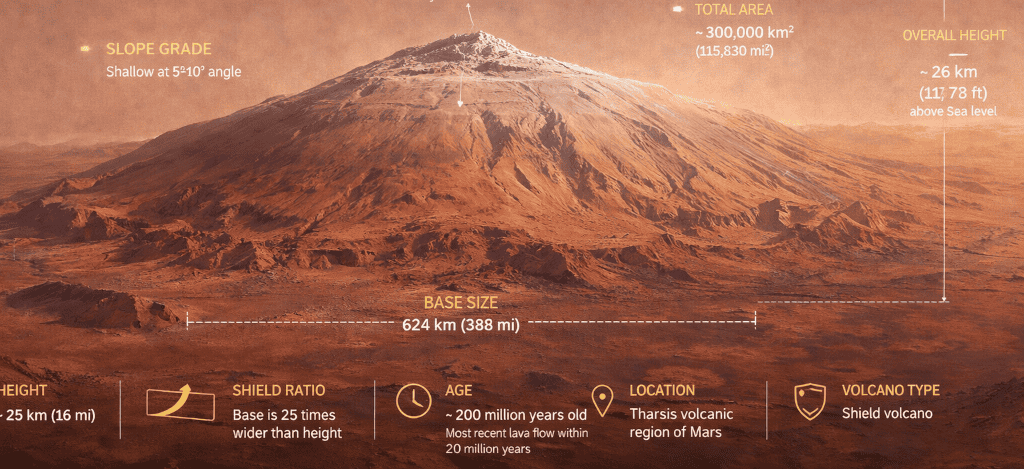
They’re on Mars. And the absolute giant among them is Olympus Mons — the tallest mountain in the Solar System.
It rises about 21–22 kilometers high. That’s more than twice the height of Mauna Kea (if you measure it from the ocean floor).
#3 Of about 80,000 WWI troops in the Austrian Alps, thousands died in avalanches
During World War I — especially in 1916–1917 — fighting in the Alps between Austria-Hungary and Italy came with a different kind of threat. Heavy snowfall triggered massive avalanches that buried entire positions. Thousands of soldiers died this way instead of in combat.
#4 Around 1–1.2 billion people live in mountain regions
Around 1.0–1.2 billion people live in mountain regions. And far beyond that, entire cities and countries depend on them for fresh water and resources.
At the same time, they’re still not fully explored. Remote valleys, isolated peaks, and hard-to-reach zones continue to reveal new species and unknown geological features.
So while mountains support billions of people… They still hold parts of the planet we haven’t fully discovered yet.
#5 The 79 AD eruption of Mount Vesuvius buried the whole city under volcanic ash
In 79 AD, the eruption of Mount Vesuvius destroyed the Roman cities of Pompeii, Herculaneum, and Stabiae. An estimated 2,000–16,000 people were killed. The volcano ejected ash to a height of about 30 km, completely burying the cities under layers of volcanic material.
#6 Mountains grow by about 5 mm per year
People often think mountains are permanent and unchanging, but the Himalayas are rising by about 5 mm per year due to tectonic plate movement. It may sound small, but over centuries it adds up to significant geological change.
This uplift happens because the Indian plate continues to push northward, forcing the crust to buckle and fold upward. At the same time, erosion from wind, rivers, ice, and landslides constantly wears the mountains down. The result is a dynamic balance between uplift and erosion, meaning the Himalayas are never truly “finished” — they are always being reshaped.
#7 Mount Everest is not the tallest mountain in the world
Most people think Mount Everest is the tallest mountain on Earth. But that depends on how you measure it.
If you start from sea level — sure, Everest wins at 8,848.86 meters (29,031.7 feet). But if you measure from the very base, things get more interesting.
The actual tallest mountain is Mauna Kea in Hawaii. Most of it is hidden underwater. From the ocean floor to its peak, it rises over 10,200 meters. Which means it quietly surpasses Everest — just in a way most people never think about.